
Die stärksten Marken sind heute jene, die KI nicht nachbilden kann.
Über weite Strecken der Marketinggeschichte entstand Vorsprung dadurch, Dinge besser zu machen: ein besseres Produkt, eine schärfere Botschaft, eine stärkere Kampagne. KI beendet das. Wenn alle dieselben Werkzeuge nutzen, gleichen sich Inhalte, Botschaften, selbst Produkte einander an. Das Ergebnis wird billiger und schneller – und dabei immer ähnlicher.
Was KI nicht kopieren kann: Was sich nicht angleicht, ist die Identität. KI kann reproduzieren, was Sie sagen und wie Sie es sagen – aber nicht, wofür Sie wirklich stehen oder warum es Ihre Marke gibt. Während die Märkte ins Gleichförmige abdriften, wird genau das zu Ihrem letzten dauerhaften Vorteil – und zu einem wirtschaftlichen: Eine Marke mit klarer Identität hält ihren Preis, während austauschbare Wettbewerber zum Rabatt greifen. Die eigentliche Frage lautet nicht länger, wie man besser kommuniziert, sondern ob man wirklich definiert hat, wer man ist – das ist es, worauf es jetzt ankommt.
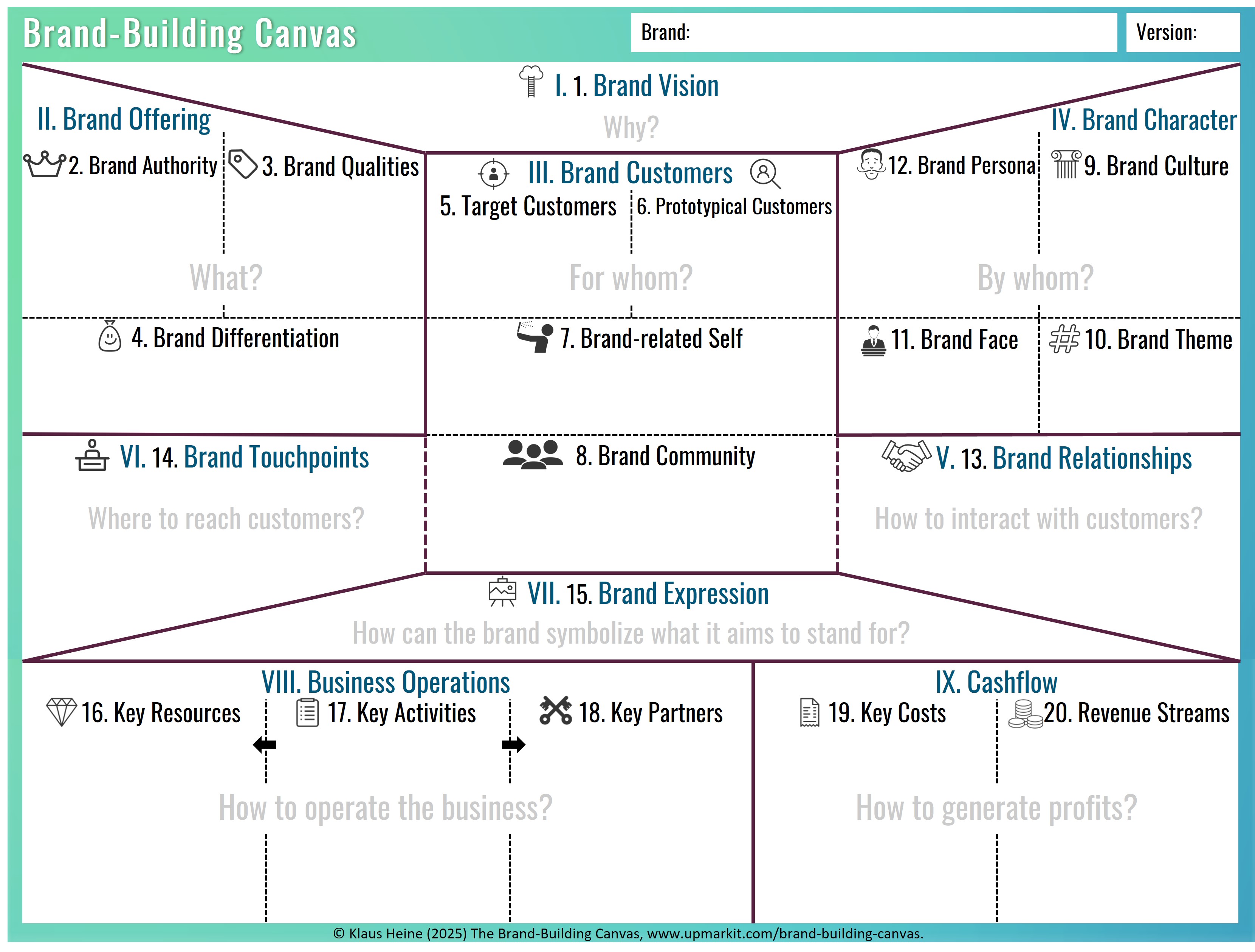
Was der Brand-Building Canvas ist: Das zu definieren ist der schwierige Teil, denn wer ein Unternehmen aufbaut, baut immer auch eine Marke auf – und eine Marke aufzubauen heißt, ihre Identität zu entwickeln. Der Brand-Building Canvas vereint daher alle Aspekte gängiger Ansätze zur Geschäftsmodellierung (z. B. das Business Model Canvas von Osterwalder & Pigneur) mit den wichtigsten Modellen der Markenidentitäts-Planung – und lässt sich sowohl zur Analyse als auch zur Planung eines Geschäftsmodells und einer Markenidentität einsetzen.
Warum das heute ein finanzielles Argument ist, kein weiches: Wenn die Märkte enger werden, ist der erste Reflex der Rabatt. Doch Rabatt gibt man, wenn einen nichts unterscheidet außer dem Preis – und die von KI getriebene Gleichförmigkeit drängt jede austauschbare Marke genau dorthin. Eine klare Identität durchbricht diesen Reflex: Sie gibt Kunden einen Grund, Ihren Preis zu zahlen – einen, den ein billigerer, ähnlich aussehender Wettbewerber nicht kopieren kann. Das ist keine Frage des Geschmacks. Zu definieren, wer Sie sind, heißt am Ende, Ihre Marge zu verteidigen.
Lizenz: Frei zur Nutzung und Weitergabe
Der Brand-Building Canvas ist lizenziert unter der Creative Commons Namensnennung – Weitergabe unter gleichen Bedingungen 4.0 International Lizenz (CC BY-SA 4.0). Das bedeutet: Sie dürfen dieses Werk vervielfältigen, verbreiten und sowohl privat als auch kommerziell frei nutzen.[...]
Namensnennung
„BY“ bedeutet „durch / von“ im Sinne von „das Werk ist von …“ und verpflichtet Nutzer dazu, den Urheber immer zu nennen. Bei jeder Nutzung muss klar erkennbar sein, dass der Brand-Building Canvas von Klaus Heine stammt. Bitte verwenden Sie folgende Form der Namensnennung: Brand-Building Canvas © Klaus Heine – Upmarkit.com
Für Bearbeitungen oder spezialisierte Versionen des Brand-Building Canvas wird folgende Namenskonvention empfohlen: Brand-Building Canvas: [Themenbereich] Edition, z. B. Brand-Building Canvas: Hospitality Edition.
Weitergabe unter gleichen Bedingungen
„SA“ (ShareAlike) bedeutet, dass Übersetzungen, Bearbeitungen oder Weiterentwicklungen ebenfalls unter derselben Lizenz veröffentlicht werden müssen. Wer also eine neue Version erstellt, darf diese verbreiten, muss sie aber ebenfalls als CC BY-SA freigeben und die Quelle nennen. [...]
What does each Brand Identity Element mean?
Brand Vision
What should the brand ultimately achieve for its customers, society, and the business itself?

Brand Vision captures the overarching goals of a brand: what it ultimately wants to achieve for its customers, society, and the business itself. As its North Star, it brings together the brand’s Mission for customers and Purpose for society with its longer-term Vision and shorter-term Ambitions for the business. Together, these goals align employees, partners, and investors behind the same desired future.
Brand Offering
Why should customers choose the brand?

The Brand Offering block answers why the brand should be chosen. It captures the product-related and functional basis of the brand’s value proposition by clarifying the field in which the brand can claim authority, the qualities and standards customers should consistently expect, and the strongest reason to choose it over competitors.
Brand Authority
In what area should the brand be seen as especially strong and competent - a product category, a skill, a usage occasion, or a customer problem it solves better than others?

Brand Authority defines the area in which the brand wants to be seen as especially strong and competent. It may focus on a product category, material, skill, usage occasion, or customer problem the brand is particularly good at solving. It gives customers a reason to trust that the brand can deliver its promise.
Brand Qualities
Which three to five product-related qualities should give customers good reasons to choose the brand?

Brand Qualities define the three to five functional, product-related characteristics customers should associate with the brand, such as durability, comfort, performance, convenience, or value for money. They should reflect the main criteria customers use to compare alternatives and guide what the brand must deliver consistently.
Key Differentiator
What should be the strongest reason for customers to choose the brand over competitors?

While Brand Qualities describe the broader set of characteristics the brand seeks to deliver, the Key Differentiator captures its most important relative advantage. It may consist of one leading quality, a distinctive combination of qualities, or a particular way of making a benefit available to customers.
Brand Customers
For whom is the brand designed, and what role should it play in customers’ lives?

The Brand Customers block defines for whom the brand is designed and how it should become meaningful in customers’ lives. It brings together the intended Target Customers, the desired image of the Prototypical User, the feelings and self-perceptions the brand should evoke, and the community to which customers should feel connected.
Target Customers
Which specific customer group should the brand primarily aim to attract?

Target Customers are the customer group the brand is primarily designed to attract. Defining them clarifies whose needs, preferences, purchase criteria, and life situation should guide the offering, communication, channels, and customer experience. This does not exclude other customers, but establishes whose expectations should receive primary attention.
Prototypical User
What kind of person should customers imagine as the brand’s typical user?

The Prototypical User is the kind of person brand managers want customers to imagine when they think of the brand. This image often differs from the actual customer base. Because customers consider whether they identify with or aspire to this user image, shaping it deliberately can make the brand more desirable or create a barrier to purchase.
Brand-related Self
When using the brand, how should customers feel and who should they believe they are or can become?

The Brand-related Self describes how customers should feel and who they should believe they are or can become when using the brand. The brand may help them confirm or express who they already are, experience a desired emotion, or move closer to the person and lifestyle they would like to achieve.
Brand Community
Which group of people should customers feel they belong to through the brand?

Brand Community defines the social group, scene, or movement customers should feel connected to through the brand. The community may involve direct interaction or exist mainly as an imagined connection among like-minded people who share similar values, interests, activities, or aspirations.
Brand Character
Who is the brand as a cultural and human actor?

The Brand Character block captures the cultural and symbolic meanings the brand should convey. These meanings emerge from four sources: the cultural world from which the brand draws meaning, the themes it continually explores, its imagined human persona, and the real people who visibly represent it.
Brand Culture
What cultural roots should shape the brand and give it meaning?

Brand Culture defines the cultural foundations from which the brand derives meaning, such as a country, city, subculture, tradition, philosophy, or way of thinking. Together with the brand’s values, these references can inspire its identity, give it depth, and become an important source of differentiation.
Brand Theme
What overarching theme should guide what the brand keeps talking about, showing, or teaching beyond its products?

The Brand Theme sets out the overarching thematic idea that gives the brand’s content, expression, and touchpoints a coherent direction over time. It identifies what the brand should repeatedly discuss, interpret, or teach beyond its products and helps it avoid disconnected content while developing recurring formats.
Brand Persona
What imagined human character should guide how the brand looks, speaks, and behaves?

Brand Persona describes the brand’s imagined human character: the kind of person it would be if it were human. It may include personality traits, life goals, and lifestyle preferences that create a vivid character and guide how the brand communicates, behaves, and presents itself.
Brand Face
Which real person or group inside the company should represent the brand - and what kind of people should customers know stand behind it?

Brand Face is about the real people who visibly represent the brand, such as founders, CEOs, creative directors, or other company representatives - and, more broadly, what kind of people stand behind it. A credible Brand Face can humanize the organization, strengthen trust and goodwill, and create a greater sense of personal closeness.
Brand Relationship
What role should the brand play in customers’ lives - as an expert, host, coach, curator, or companion - and in what tone should it address them?

Brand Relationship defines how the brand wants to relate to its customers. This includes the role it wants to play in their lives, the kind of bond customers should experience, and the tone in which the brand addresses them. A distinctive relationship can help the brand behave differently from competitors and reshape the category experience.
Key Touchpoints
Which few communication, distribution, or service touchpoints should the brand become especially known for?

Key Touchpoints are the few communication, distribution, and service encounters through which customers should experience the brand and for which it wants to become known. They are not a complete channel list, but selected identity-bearing touchpoints that can bring the brand to life and become recognizable brand signatures.
Brand Expression
Which few recurring signature elements should express what the brand stands for and make it recognisable, even without its name?

Brand Expression defines how the brand should look, sound, feel, speak, and act to express its intended meaning. The goal is to develop a small set of recurring signature elements, such as a colour, symbol, sound, phrase, or ritual, that make the brand recognisable even when its name or logo is absent.
Lorem ipsum dolor sit amet, consetetur sadipscing elitr, sed diam nonumy eirmod tempor invidunt ut labore et dolore magna aliquyam erat, sed diam voluptua. At vero eos et accusam et justo duo dolores et ea rebum. Stet clita kasd gubergren, no sea takimata sanctus est Lorem ipsum dolor sit amet. Lorem ipsum dolor sit amet, consetetur sadipscing elitr, sed diam nonumy eirmod tempor invidunt ut labore et dolore magna aliquyam erat, sed diam voluptua. At vero eos et accusam et justo duo dolores et ea rebum. Stet clita kasd gubergren, no sea takimata sanctus est Lorem ipsum dolor sit amet.