Brand-Building Canvas In an AI-driven market, identity is the last real difference. The Brand-Building Canvas is the framework that defines yours.

Paragraphs

In Brief: What Is the Brand-Building Canvas?

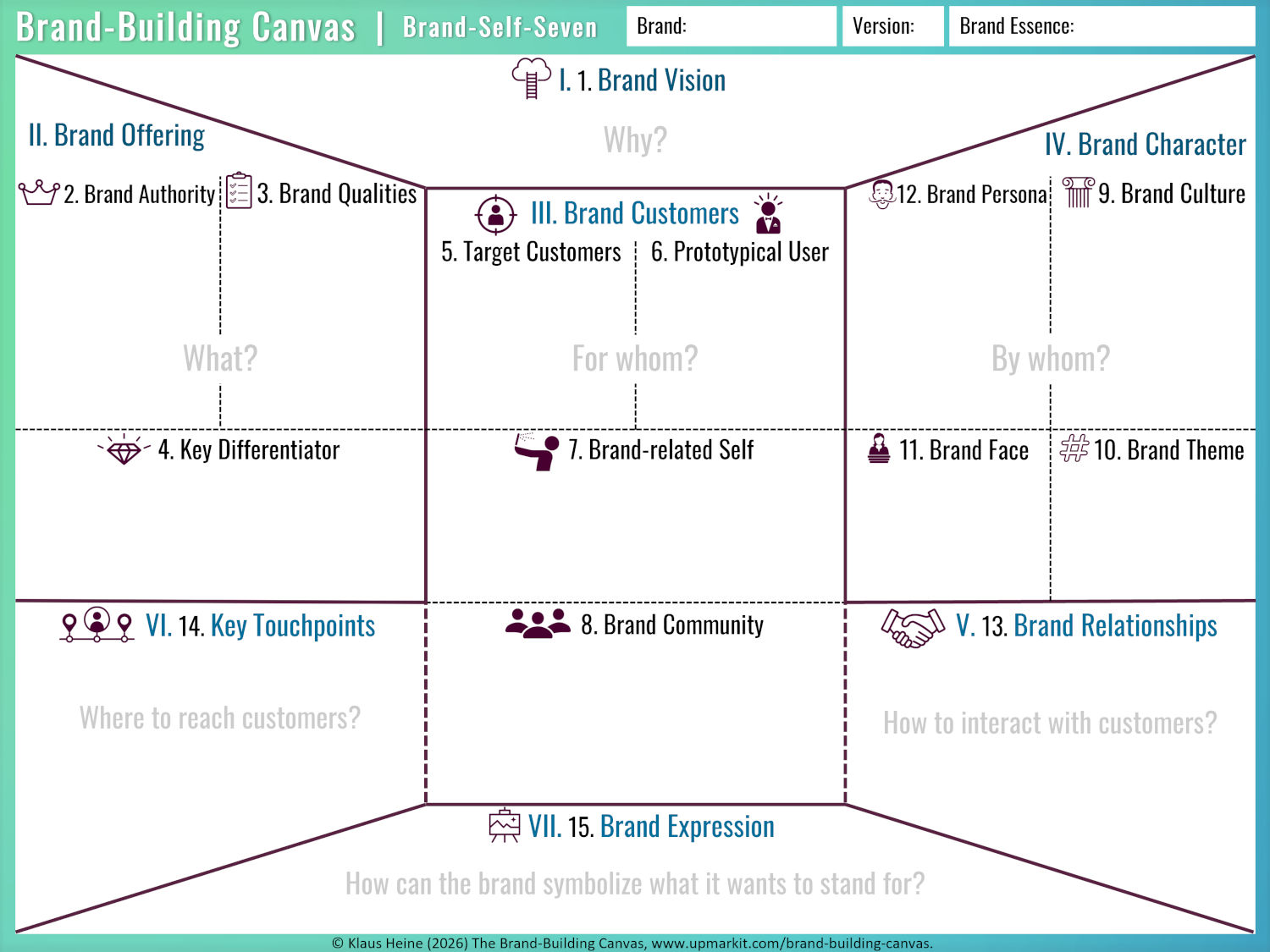
The Brand-Building Canvas is a practical tool for developing brand identity – that is, for working out what a brand should stand for and what brand DNA and aura it should embody. It can be used as a brand strategy framework for building, reviewing, and repositioning brands. The Canvas structures brand identity into seven blocks with a total of 15 elements. This helps brand teams systematically work out what the brand should stand for, who it should be for, and what should set it apart from competitors.


How Can You Build a Brand That AI Cannot Easily Reproduce?

  1. AI is available to everyone

    Every company gets access to the same powerful AI tools, at low costs.

    AI becomes ubiquitous

    but

  2. AI produces the average

    It is trained on everything that already exists. Without a clear direction, it returns what is most common.

    this leads to

  3. Growing sameness: Everything starts to look alike

    When everyone uses the same tools, the resulting texts, images, campaigns and even products start to look more similar.

    Growing sameness: Everything starts to look alike

    which means

  4. What can be easily copied becomes replaceable

    If the advantage lies only in the quality of the output, competitors can reproduce it. And when the difference can be reproduced, the brand becomes replaceable. So what still sets a brand apart?

    so

  5. Brand identity creates harder-to-copy differentiation

    Real differentiation comes from a strong brand identity: what it stands for, where it comes from, what it has actually done, and how it operates internally.

    Identity is what sets a brand apart

    because

  6. AI copies only the surface

    AI can copy what a brand says, but not what makes those words believable. When competitors simply claim the same thing, it sounds borrowed, because nothing stands behind it. Identity is rooted in what a brand believes and does, and in its history, people, culture, and commitments - things that are much harder to reproduce without changing the company itself.

    at the same time

  7. Brand identity gives customers a reason to choose beyond price

    A distinctive identity creates meanings, associations, and experiences that go beyond functional benefits and make one brand more meaningful than another.

    Identity creates value beyond the product

    which supports

  8. A strong identity helps defend price and margin

    Brands that remain meaningfully different are less dependent on discounting and better able to hold their price.

    while also

  9. Identity makes AI work for you

    AI builds on whatever direction it is given. With a defined identity, it produces something distinctly yours. Without one, it produces the average.
  10. Key Takeaways

    Identity protects strategic value

    A strong identity can help brands preserve differentiation, strengthen pricing power, and reduce their exposure to price competition and discounting.
     

    Defining brand identity becomes a strategic priority

    In the age of AI, competitive advantage increasingly shifts from producing better outputs to providing more distinctive inputs - above all, a strong brand identity that also gives AI clear direction.
     

    The Brand-Building Canvas provides the structure

    Getting your identity right is the real work. Many companies have the potential for a distinctive identity, but have never really thought about it. To unlock that potential, the identity has to be worked out. That is exactly what the Brand-Building Canvas is made for.

The Brand-Building Canvas at a Glance
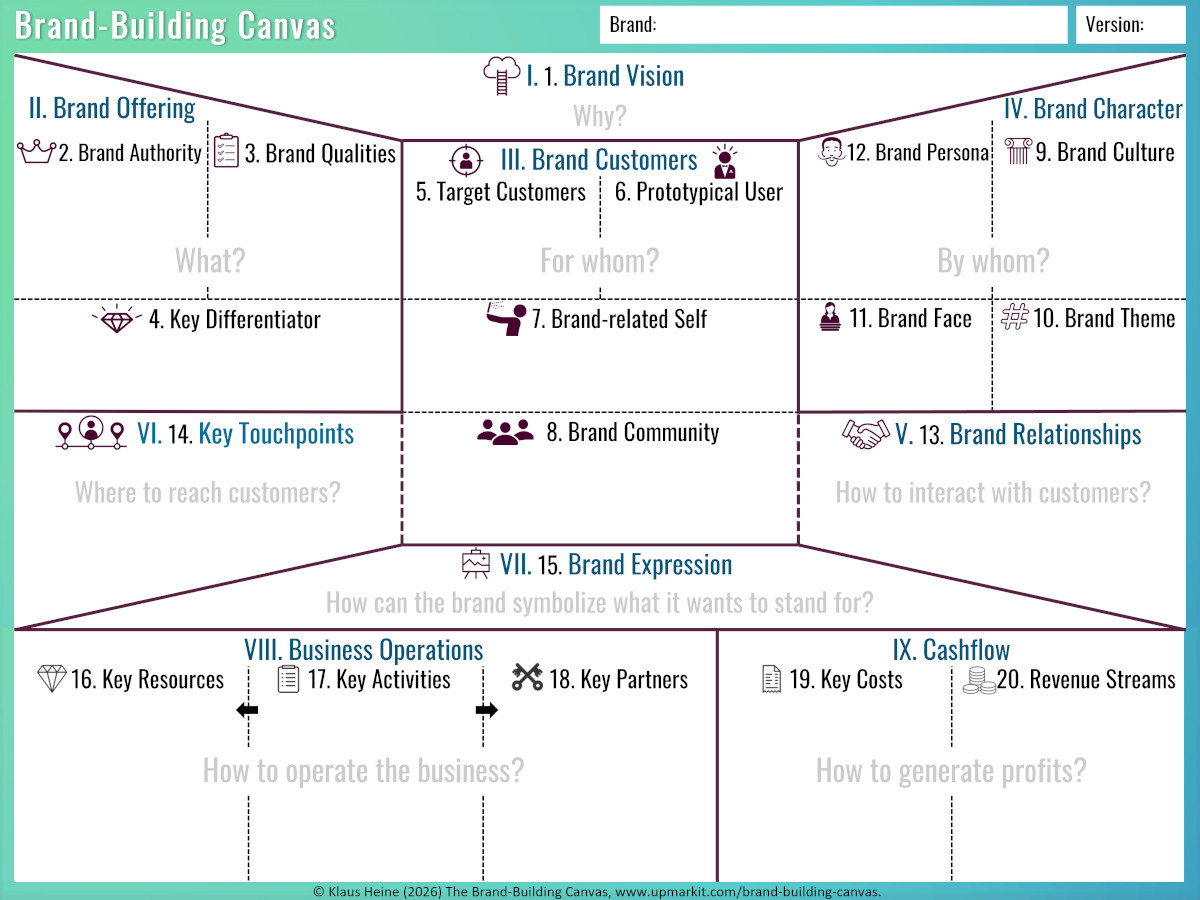

Brand-Building Canvas 


License: Free to Use and Share

The Brand-Building Canvas is licensed under the Creative Commons Attribution – ShareAlike 4.0 International Licence (CC BY-SA 4.0). This means you are free to copy, distribute, and use this work for both private and commercial purposes.[...]

Attribution
“BY” means “the work is by …” and requires users to always credit the author. In every use, it must be clear that the Brand-Building Canvas was created by Klaus Heine. Please use the following attribution format:
Brand-Building Canvas © Klaus Heine – Upmarkit.com 

For adaptations or specialized versions of the Brand-Building Canvas, the following naming convention is suggested:
Brand-Building Canvas: [Topic] Edition, e.g. Brand-Building Canvas: Hospitality Edition.

ShareAlike
“SA” (ShareAlike) means that translations, adaptations, or modifications must also be published under the same license. Anyone creating a new version may distribute it, but must also release it under CC BY-SA and credit the source. [...]
 

Heine, K. (2026) Brand-Building Canvas, Upmarkit, https://upmarkit.com/de/brand-building-canvas.


The Framework

What Are the Components of Brand Identity? 
An Overview of the Seven Identity Blocks of the Brand-Building Canvas 

Seven of the nine blocks describe the brand identity itself. Two further blocks cover the business behind it.

  • 01

    Brand Vision

    What should the brand ultimately achieve for its customers, for society, and for the business itself?

    Mission · Purpose · Vision · Ambitions

  • 02

    Brand Offering

    Why should customers choose the brand — what makes it valuable and distinctive?

    Brand Authority · Brand Qualities · Key Differentiator

  • 03

    Brand Customers

    For whom is the brand designed, and what role should it play in customers' lives?

    Target Customers · Prototypical User · Brand-related Self · Brand Community

  • 04

    Brand Character

    Who is the brand as a cultural and human actor?

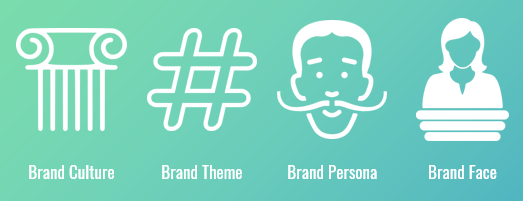
    Brand Culture · Brand Theme · Brand Persona · Brand Face

  • 05

    Brand Relationship

    How does the brand relate to its customers and in what tone should it address them?

  • 06

    Key Touchpoints

    Which few communication, distribution, or service touchpoints should the brand become known for?

  • 07

    Brand Expression

    Which few recurring signature elements should express what the brand stands for?

  • 08 — 09

    The business behind it

    Two further blocks connect the identity to the business it has to serve.

What does each Brand Identity Element mean?

Brand Vision

What should the brand ultimately achieve for its customers, society, and the business itself?

Brand Vision

Brand Vision captures the overarching goals of a brand: what it ultimately wants to achieve for its customers, society, and the business itself. As its North Star, it brings together the brand’s Mission for customers and Purpose for society with its longer-term Vision and shorter-term Ambitions for the business. Together, these goals align employees, partners, and investors behind the same desired future.


Brand Offering

Why should customers choose the brand?

Brand Offering

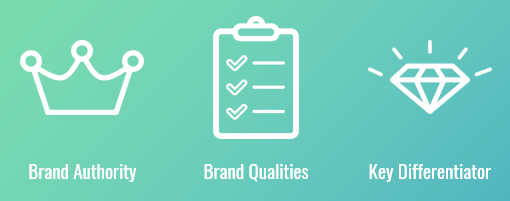
The Brand Offering block answers why the brand should be chosen. It captures the product-related and functional basis of the brand’s value proposition by clarifying the field in which the brand can claim authority, the qualities and standards customers should consistently expect, and the strongest reason to choose it over competitors.


Brand Authority

In what area should the brand be seen as especially strong and competent - a product category, a skill, a usage occasion, or a customer problem it solves better than others?

Brand Authority

Brand Authority defines the area in which the brand wants to be seen as especially strong and competent. It may focus on a product category, material, skill, usage occasion, or customer problem the brand is particularly good at solving. It gives customers a reason to trust that the brand can deliver its promise.


Brand Qualities

Which three to five product-related qualities should give customers good reasons to choose the brand?

Brand Qualities

Brand Qualities define the three to five functional, product-related characteristics customers should associate with the brand, such as durability, comfort, performance, convenience, or value for money. They should reflect the main criteria customers use to compare alternatives and guide what the brand must deliver consistently.


Key Differentiator

What should be the strongest reason for customers to choose the brand over competitors?

Key Differentiator

While Brand Qualities describe the broader set of characteristics the brand seeks to deliver, the Key Differentiator captures its most important relative advantage. It may consist of one leading quality, a distinctive combination of qualities, or a particular way of making a benefit available to customers.


Brand Customers

For whom is the brand designed, and what role should it play in customers’ lives?

Brand Customers

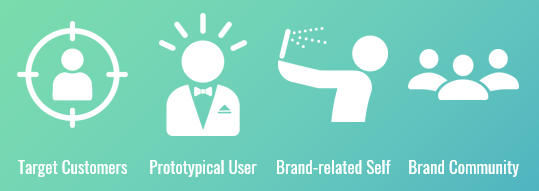
The Brand Customers block defines for whom the brand is designed and how it should become meaningful in customers’ lives. It brings together the intended Target Customers, the desired image of the Prototypical User, the feelings and self-perceptions the brand should evoke, and the community to which customers should feel connected.


Target Customers

Which specific customer group should the brand primarily aim to attract?

Target Customers

Target Customers are the customer group the brand is primarily designed to attract. Defining them clarifies whose needs, preferences, purchase criteria, and life situation should guide the offering, communication, channels, and customer experience. This does not exclude other customers, but establishes whose expectations should receive primary attention.


Prototypical User

What kind of person should customers imagine as the brand’s typical user?

Prototypical User

The Prototypical User is the kind of person brand managers want customers to imagine when they think of the brand. This image often differs from the actual customer base. Because customers consider whether they identify with or aspire to this user image, shaping it deliberately can make the brand more desirable or create a barrier to purchase.


Brand-related Self

When using the brand, how should customers feel and who should they believe they are or can become?

Brand-related Self

The Brand-related Self describes how customers should feel and who they should believe they are or can become when using the brand. The brand may help them confirm or express who they already are, experience a desired emotion, or move closer to the person and lifestyle they would like to achieve.


Brand Community

Which group of people should customers feel they belong to through the brand?

Brand Community

Brand Community defines the social group, scene, or movement customers should feel connected to through the brand. The community may involve direct interaction or exist mainly as an imagined connection among like-minded people who share similar values, interests, activities, or aspirations.


Brand Character

Who is the brand as a cultural and human actor?

Brand Character

The Brand Character block captures the cultural and symbolic meanings the brand should convey. These meanings emerge from four sources: the cultural world from which the brand draws meaning, the themes it continually explores, its imagined human persona, and the real people who visibly represent it.


Brand Culture

What cultural roots should shape the brand and give it meaning?

Brand Culture

Brand Culture defines the cultural foundations from which the brand derives meaning, such as a country, city, subculture, tradition, philosophy, or way of thinking. Together with the brand’s values, these references can inspire its identity, give it depth, and become an important source of differentiation.


Brand Theme

What overarching theme should guide what the brand keeps talking about, showing, or teaching beyond its products?

Brand Theme

The Brand Theme sets out the overarching thematic idea that gives the brand’s content, expression, and touchpoints a coherent direction over time. It identifies what the brand should repeatedly discuss, interpret, or teach beyond its products and helps it avoid disconnected content while developing recurring formats.


Brand Persona

What imagined human character should guide how the brand looks, speaks, and behaves?

Brand Persona

Brand Persona describes the brand’s imagined human character: the kind of person it would be if it were human. It may include personality traits, life goals, and lifestyle preferences that create a vivid character and guide how the brand communicates, behaves, and presents itself.


Brand Face

Which real person or group inside the company should represent the brand - and what kind of people should customers know stand behind it?

Brand Face

Brand Face is about the real people who visibly represent the brand, such as founders, CEOs, creative directors, or other company representatives - and, more broadly, what kind of people stand behind it. A credible Brand Face can humanize the organization, strengthen trust and goodwill, and create a greater sense of personal closeness.


Brand Relationship

What role should the brand play in customers’ lives - as an expert, host, coach, curator, or companion - and in what tone should it address them?

Brand Relationship

Brand Relationship defines how the brand wants to relate to its customers. This includes the role it wants to play in their lives, the kind of bond customers should experience, and the tone in which the brand addresses them. A distinctive relationship can help the brand behave differently from competitors and reshape the category experience.


Key Touchpoints

Which few communication, distribution, or service touchpoints should the brand become especially known for?

Key Touchpoints

Key Touchpoints are the few communication, distribution, and service encounters through which customers should experience the brand and for which it wants to become known. They are not a complete channel list, but selected identity-bearing touchpoints that can bring the brand to life and become recognizable brand signatures.


Brand Expression

Which few recurring signature elements should express what the brand stands for and make it recognisable, even without its name?

Brand Expression

Brand Expression defines how the brand should look, sound, feel, speak, and act to express its intended meaning. The goal is to develop a small set of recurring signature elements, such as a colour, symbol, sound, phrase, or ritual, that make the brand recognisable even when its name or logo is absent.