
Brand Identity Prism
Prisme d'Identité de Marque
Jean-Noël Kapferer · HEC Paris
Purpose & Claim
Why Kapferer Built the Prism
Kapferer developed the prism for two reasons.
To separate identity from image. Many companies mixed up the two and steered their brand only by how customers saw it at a given moment. Image is how the public sees the brand. It reacts to what the brand does. Identity is the brand's own choice of what it wants to stand for, and it comes first: "Before projecting an image to the public, we must know exactly what we want to project" (Kapferer, 2008, p. 174). With a clear identity, a brand can shape how it is seen instead of chasing short-lived opinions.
To look behind the logo. Many people thought of a brand as its logo, colours and design. Kapferer's contribution was to show what lies behind them. This matters because competitors can quickly copy a product and its look, so many brands end up looking alike. When cars share the same chassis and engine, what still sets them apart is mainly their brand identity (Kapferer, 2008, pp. 173–174). So the prism covers both sides: what you can see, such as the design, and what lies inside the brand, such as its personality, values and culture (Kapferer, 2008, p. 187).
The Model
Six Facets on Two Axes
Structural Logic
Sender and Recipient, Outside and Inside
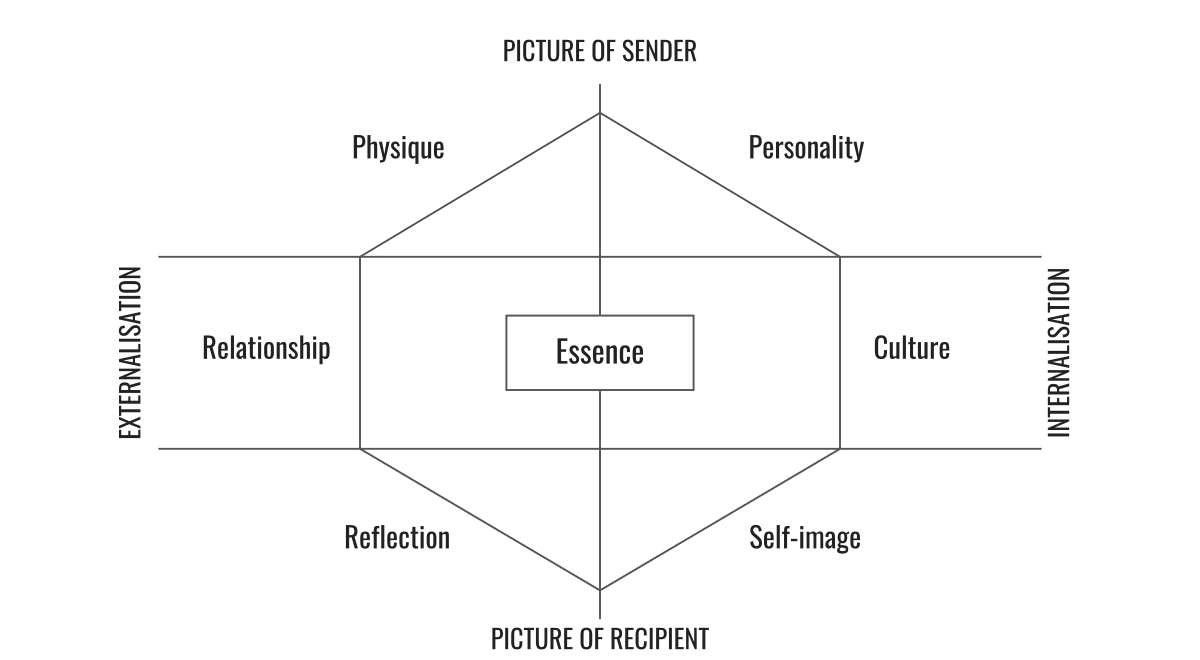
The prism rests on one idea: brands "have the gift of speech" and only exist if they communicate. So a brand can be analysed like any other speech (Kapferer, 2008, p. 187). Two axes follow from this:
- Sender and recipient (top to bottom): physique and personality describe the brand as sender. Reflection and self-image describe the recipient. Relationship and culture link the two (Kapferer, 2008, p. 187).
- Outside and inside (left to right): physique, relationship and reflection, on the left, are the visible facets that show the brand to the outside world. Personality, culture and self-image, on the right, lie inside the brand, "within its spirit" (Kapferer, 2008, p. 187).
The six facets are linked and form one well-structured whole: "the content of one facet echoes that of another". Together they set the limits within which the brand can change and grow (Kapferer, 2008, p. 187).
Elements
Seven Facets as Kapferer Defines Them
Definitions follow Kapferer (2008, pp. 180–198). All examples are his own.
Picture of Sender
01
Physique
The brand's physical traits and qualities. These are either objective features that people name right away when asked about the brand, or newer features that are still emerging. "Physique is both the brand's backbone and its tangible added value." Kapferer's own image: "If the brand is a flower, its physique is the stem." Without the stem, the flower dies. Physique also includes the brand's flagship product (Kapferer, 2008, pp. 182–183).
Guiding questions: What is it concretely? What does it do? What does it look like? (Kapferer, 2008, p. 183).
Orangina: the small round bottle with visible orange pulp. It has not changed since the beginning and is central to every launch in a new country (Kapferer, 2008, p. 183).02
Personality
By communicating, a brand slowly builds up a character. The way it talks about its products shows "what kind of person it would be if it were human". This is the personality of the brand as sender. It should not be confused with the reflected customer, which is a picture of the ideal buyer (Kapferer, 2008, pp. 183–184).
Spokespersons: the easiest way to give a brand instant personality is a spokesperson or figurehead, real or symbolic. Pepsi-Cola often does this, and so do all perfume and ready-to-wear brands (Kapferer, 2008, p. 184).
Bridge Between Sender and Recipient
03
Relationship
Brands often sit at the heart of exchanges between people. This facet "defines the mode of conduct that most identifies the brand": how the brand acts, serves and treats its customers. This facet is especially important for services, banks and retailers (Kapferer, 2008, pp. 185–186).
Nike: a provocative relationship that urges us to let loose ("just do it"). IBM stands for order, Apple for friendliness (Kapferer, 2008, p. 185).04
Culture
The values that inspire the brand. Culture is "the source of the brand's aspirational power" and sets the basic principles behind its products and communication. Kapferer places it at the core of the brand. A brand's country of origin is often a rich source of such values (Kapferer, 2008, pp. 184–185).
Mercedes: the brand stands for German values, above all order. Even at 260 km/h a Mercedes handles perfectly, and symmetry runs through the whole brand (Kapferer, 2008, pp. 184–185).
Picture of Recipient
05
Reflection
The type of customer the brand seems to be talking to. This is not the same as the target group. The brand shows customers "as he/she wishes to be seen as a result of using a brand", as a model to identify with (Kapferer, 2008, p. 186).
Coca-Cola: the brand shows 15- to 18-year-olds, yet far more people buy it. Younger children see their dream in it, adults a way of life (Kapferer, 2008, p. 186).06
Self-Image
Reflection is the outer mirror: how customers are seen by others. Self-image is the inner mirror: how customers see themselves when they use the brand (Kapferer, 2008, p. 186).
Lacoste: even customers who do no sport see themselves as members of an elegant sports club. The club is open, with no barriers of race, sex or age, yet it gives its members distinction (Kapferer, 2008, p. 186).
Centre
07
Brand Essence
The one central value the brand stands for, written in the middle of the prism (Kapferer, 2008, pp. 180, 198). It is useful for managers because it tries to sum up the richness of an identity, which makes it easier to pass on. But words mean different things in different cultures, so to really understand a brand "one really needs the full identity prism" (Kapferer, 2008, p. 198).
Nivea: pure love and care. Jack Daniel's: untamed America. Amex: sign of personal success (Kapferer, 2008, p. 198).
Application
Positioning, Brand Charters and Common Mistakes
For existing brands, positioning comes from identity. It uses one aspect of identity for a given market, at a given time and against a given set of competitors. So one identity can lead to different angles in different markets (Kapferer, 2008, pp. 180–181).
Kapferer reminds us that brand charters, the documents that set out a brand's identity, are management tools. They are needed so that people across the organisation can make decisions. They must help everyone who works on the brand understand what makes it special, spark creative ideas and help decide whether an action fits the brand or not (Kapferer, 2008, p. 187).
A good prism has few words for each facet. The words differ from facet to facet. Every word is strong, not weak, because identity is what makes a brand stand out (Kapferer, 2008, p. 187). Kapferer shows filled-in prisms for Polo Ralph Lauren and Lacoste (Kapferer, 2008, p. 188, Figure 7.5).
Common Mistakes
Kapferer warns of three mistakes he often sees in practice (Kapferer, 2008, pp. 187–188):
- Filled with image data: users often fill the facets with results from the latest customer survey, although identity is not image (Kapferer, 2008, pp. 187–188).
- Same words in several facets: users often repeat words across facets, although each facet should cover something different (Kapferer, 2008, p. 188).
- Safe, average words: many prisms play it safe with words everyone agrees on, so nothing stands out (Kapferer, 2008, p. 188).
Takeaway
Key Contributions and Limitations
Key Contributions
- Known around the world: the prism is used globally and is widely seen as the best-known brand identity model.
- From image to identity: the prism moved the focus of earlier models from how a brand is seen to what it is (Urde, 2013, p. 745).
- Built on theory: it rests on communication theory, not on a loose list of items put together without a theory, as Kapferer himself argues (Kapferer, 2008, p. 182).
- Opening to corporate brands: the culture facet and the split into inner and outer facets make the prism a bridge between product brand models and corporate brand models (Urde, 2013, pp. 745–746).
- Stable, yet free to move: identity fixes what must stay and what may change, so positioning can shift across markets and over time while the brand stays itself (Kapferer, 2008, pp. 173, 181).
Limitations
- Leans towards product brands: despite that link, the focus on self-image and reflection makes the prism a better fit for product brands than for corporate brands (Urde, 2013, p. 745).
- Missing elements that are central today: the prism leaves out elements that are key to brand identity today, for instance the brand's vision or purpose.
References
- Kapferer, J.-N. (2008). The New Strategic Brand Management: Creating and Sustaining Brand Equity Long Term (4th ed.). Kogan Page.
- Urde, M. (2013). The Corporate Brand Identity Matrix. Journal of Brand Management, 20(9), 742–761. https://doi.org/10.1057/bm.2013.12
Part of the Brand Identity Model Atlas. The atlas underpins the Brand-Building Canvas: a practical one-page brand identity and strategy framework for building, auditing, and repositioning brands. Download the PDF or PowerPoint template, or compare all brand identity models in the overview.